
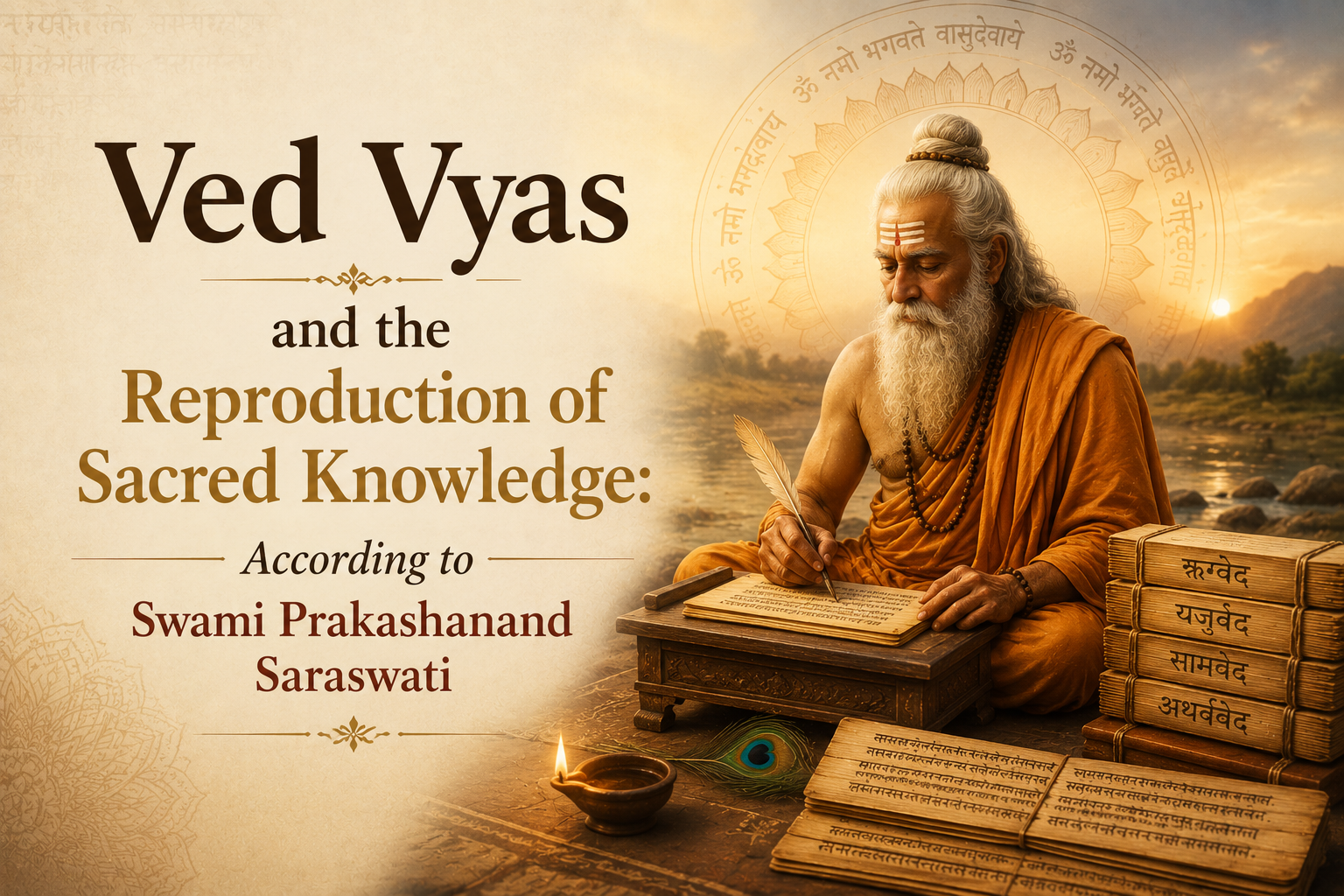
Some traditions treat their scriptures as documents written once, by a single author, at a single point in history. Sanatan Dharma, in the account Swami Prakashanand Saraswati gives in The True History and the Religion of India, treats its scriptures very differently: as eternal knowledge that gets reproduced, generation after generation, by Divine personalities who receive and reorganize it for the age they live in. The central figure in this story is Ved Vyas.
The Structure of the Vedas
Swami Prakashanand Saraswati lays out the architecture of the Vedas in three parts. The mantra or sanhita section holds invocative verses used in fire ceremonies and general prayer, along with a few portions, like the Purush Sookt of the Rigved and the Ishopnishad, that speak directly of the supreme God. The Brahman section describes how those ceremonies are performed and includes guidance on worshipping various forms of God. The aranyak section is the distilled essence of the Vedas, focused on God, devotion, and His supremacy, and this final portion is what we know as the Upnishads.
There are four Vedas: Rigved, Yajurved, Samved, and Atharvaved. Together, they span 1,180 branches, with a corresponding 1,180 sections of Brahman and 1,180 Upnishads. Only a portion of the mantra and brahman material survives today, and around 200 of the Upnishads remain available.
Grammar as Divine Evidence
Swami Prakashanand Saraswati explains how the history of Sanskrit grammar isit’s own evidence of the Divine origin of these scriptures. Various sages expanded on Vedic grammar over time, and the Nirukta explained the meanings of Vedic words. Sage Panini later composed the Ashtadhyayi, a complete grammar built from a small set of sounds, aiun, rilrik, and others, said to have been given by God Shiv himself. For Swami Prakashanand Saraswati, the fact that no human intellect has ever produced a perfect grammatical system from so small a starting point is itself proof that Sanskrit is a Divine manifestation rather than a human invention.
Reproduced, Not Just Preserved
Accordingly, the Vedas, the Upvedas(covering sociology, defense, music, and medicine), and the Vedangas (covering grammar, dictionary, and astrology) were first revealed by Brahma to the Rishis at the very beginning of creation. Ved Vyas reproduced all this material again about 5,000 years ago. He also composed the Mahabharat, dictating it to God Ganesh, who wrote it down since the work was too vast and demanding for an ordinary hand. Ved Vyas additionally reproduced the Ramayan, a work originally composed by Sage Valmiki 18 million years earlier during the period when Bhagwan Ram descended to earth.
Swami Prakashanand Saraswati clearly illuminates the purpose behind these scriptures: to guide every soul, from an ordinary worldly person to a highly evolved one, toward God realization. He describes how any person who surrenders to God with sincere, loving faith receives God’s Grace. Through that Grace, once one’sheart is purified, he receives God realization. Bhagwan Ram and Krishn descend to the earth from time to time specifically to demonstrate the greatness of this loving devotion, or bhakti. Details about their lives are recorded in the Ramayan and the Bhagwatam.
Who Was Ved Vyas
Swami Prakashanand Saraswati identifies Ved Vyas as one of the twenty-four descensions of God. God’s internal Form in each descension is absolute and eternal in nature, while externally living out a seemingly ordinary family life on earth. Ved Vyas was born to Sage Parashar. He arrived as a 12-year-old boy and went straight into the forests, where he soon began revealing the scriptures. He lived during the reign of King Shantanu, grandfather of the Pandavas. His birth name was Krishn Dwaipayan, and the title Ved Vyas came from his work systematizing the mantras of the Vedas. He is also known as Vadrayan, after the berry forests of Vadari near Badrikashram in the Himalayas where he spent part of his life.
Ved Vyas conceived the entire body of scriptures in his mind before revealing them. Swami Prakashanand Saraswati describes the order in which Ved Vyas revealed this material:
- first the Vedas with their 1,180 Upnishads and affiliated texts
- then the 17 Puranas
- then the 18 Uppuranas
- then the Mahabharat and the Ramayan
- and finally, the Bhagwatam, which he calls the Maha Puran – the supreme Puran among them.
Ved Vyas then taught these scriptures to disciples who had achieved God realization, and they carried the knowledge forward in their own minds.
Why History, Religion, and the Path to God Matter Together
Swami Prakashanand Saraswati identifies three questions that every person, caught between hope and disappointment in the world, ultimately wants answered:
- what has happened in the past, and whether anyone has genuinely found real happiness in this world
- what to do, in terms of religion, to understand God better
- and, for someone who already believes in God, what the true path to Him actually is
He argues that all three questions sit beyond the reach of ordinary human intelligence, so God reveals the answers Himself through His eternal Rishis and Sages. These revelations take the form of the Puranas, which record the full history of India, the Vedas, which lay out general religious conduct and the worship of celestial gods for material well-being, and the Upnishads, which describe the path to God directly.
Conclusion
Swami Prakashanand Saraswati’s description of Ved Vyas presents scripture not as a single act of authorship but as a chain of transmission; knowledge revealed at the dawn of creation, carried forward, and then systematically reorganized and reproduced by a Divine personality for a new age. Ved Vyas sits at the center of that chain. He is responsible for the Vedas in their current form, the Mahabharat, the Ramayan, and the Bhagwatam. Read this way, the Puranas, Vedas, and Upnishads are not separate categories of ancient literature. Rather, they are three answers to the same three questions every seeker eventually asks about the past, about right conduct, and about the path to God, and they exist together, because a person searching for meaning needs all three at once.